For anyone standing in a selection room with a price list a few days after a death, deciding what to sign for
Standing in front of forty caskets? What the price card is actually describing
With steel, a lower gauge number means thicker metal, so 18 gauge is heavier than 20 gauge. Most steel caskets on a showroom floor are one of those two.
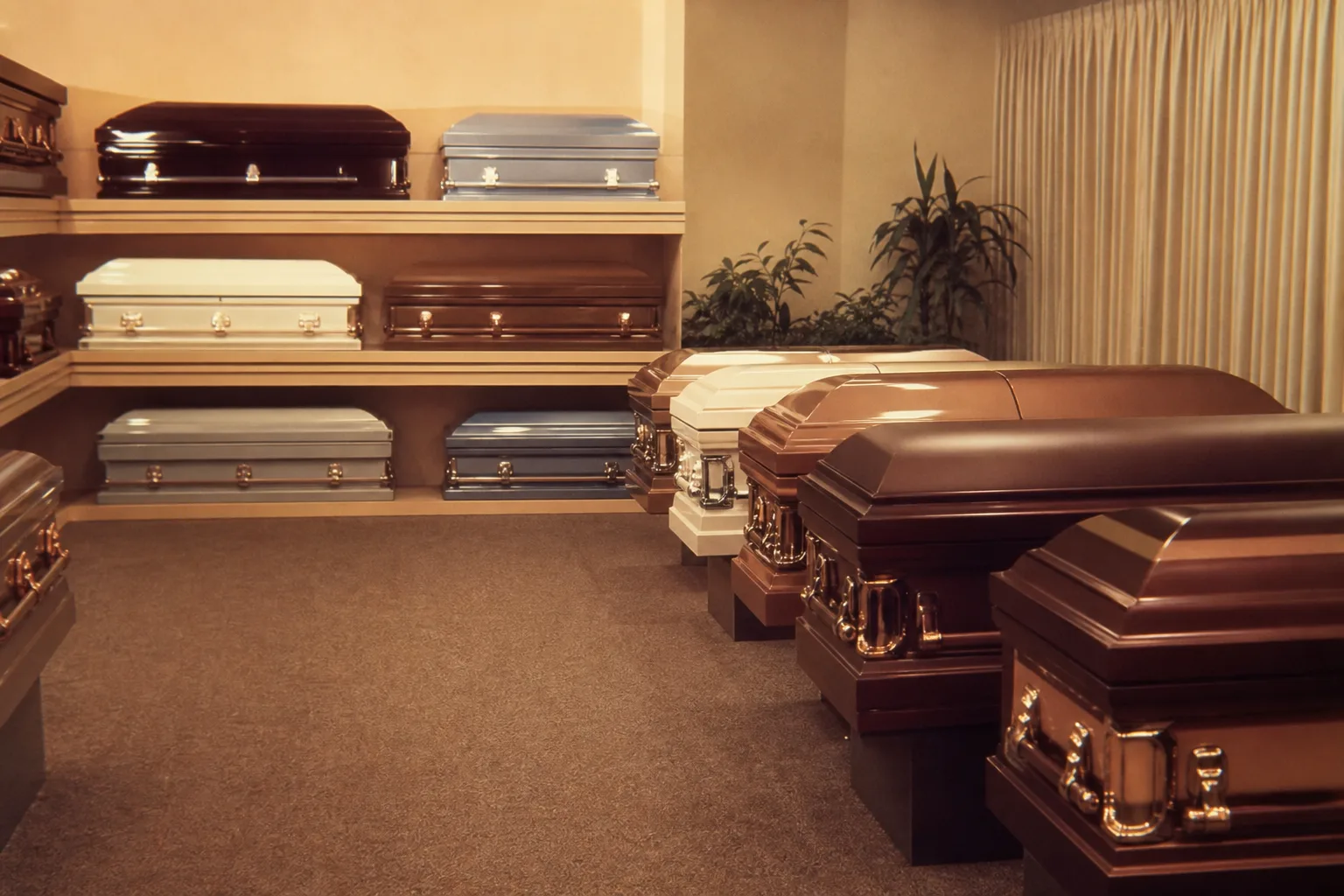
Every casket in a selection room carries a card, and the card is usually a short list of nouns: 18 gauge steel, protective, brushed silver finish, rosetan crepe interior, swing bar handles. Those nouns are doing real work, and a careful reader can price most of the difference between two boxes by understanding five of them. The Federal Trade Commission oversees funeral pricing disclosure through the Funeral Rule, and one of its practical effects is that a casket price list exists at all, which means the vocabulary on those cards can be compared item by item before anything is signed.
Gauge runs backwards, and the difference is thickness
Steel gauge is a measure where the smaller number means the thicker metal, so 18 gauge steel is heavier than 20 gauge, and 16 gauge is heavier still. The spread between 20 and 18 is real but modest, a matter of fractions of an inch in sheet thickness, and it shows up mostly in weight, in how the lid feels when it is lowered, and in resistance to denting during handling. Most steel caskets sold in the United States are 20 or 18 gauge. Stainless steel is a separate category priced above both, and copper and bronze are sold by weight per square foot rather than by gauge, which is why they sit at the top of nearly every price list.
Wood is priced by species, then by what is under the veneer
Poplar, pine and oak are ordinary domestic hardwoods and softwoods, cut and finished in volume, and a poplar casket with a walnut stain can look very close to walnut from six feet away. Mahogany, cherry and walnut cost more because the lumber costs more and the finishing is slower. The question a careful reader asks is whether the card says solid or veneer, because a veneered casket is a thin layer of the named species over a substrate that is usually poplar or an engineered panel. Neither is a defect. It is simply a different product at a different price, and the card should say which.
Hardware, corners and the interior fabric
Swing bar handles pivot down against the shell when the casket is at rest and lift out to a carrying position, which is what pallbearers usually expect to find. Stationary bars do not move, and are sometimes preferred because they are simpler and cheaper. Corner ornaments, cast or molded, are decorative and are occasionally sold as separate line items. Inside, crepe is a lighter woven fabric, velvet is heavier and deeper in color, and a twill or satin sits between them. The fabric changes the appearance and the price, but it does nothing structural, and a family that cares more about the wood than the lining can say so.
What a gasket does, and what it is not sold as doing
A gasketed casket, often labeled protective or sealed on the card, has a rubber or synthetic gasket around the rim and a locking mechanism, usually operated with a crank key, that draws the lid down against it. The stated purpose is to resist the entry of air, water and other outside elements into the casket. That is the claim manufacturers make, and it is the limit of it. Under the Funeral Rule, a seller may not tell a family that any casket or sealing feature will preserve remains indefinitely, because it will not. Sealing is a construction feature with a price attached, typically several hundred dollars between an otherwise identical gasketed and non-gasketed model, and it is a reasonable thing to buy or to decline on its own terms.
Reading two cards side by side
The useful exercise in the room is to find two caskets whose cards differ in exactly one noun, and to ask what that noun costs. Twenty gauge against 18 in the same finish, crepe against velvet in the same shell, gasketed against not. Sales staff generally know these pairings and can point them out, and a written price list has to be available on request in any case. Once the difference is priced, the decision stops being about the whole object and becomes a series of small, separable choices, which is a far easier way to spend several thousand dollars.
Bring the price list home if the timeline allows it. The vocabulary is short, the comparisons are arithmetic, and an hour with the list at a kitchen table tends to produce a choice the family is settled about later.