choosing and paying for burial and cremation containers, including caskets, grave liners and outer burial vaults
Walking into a selection room tomorrow? What the arrangement is doing to your budget
Showroom layout, price ordering and the half-couch lid all shape a purchase made in a hurry, and each one has a dollar figure attached.
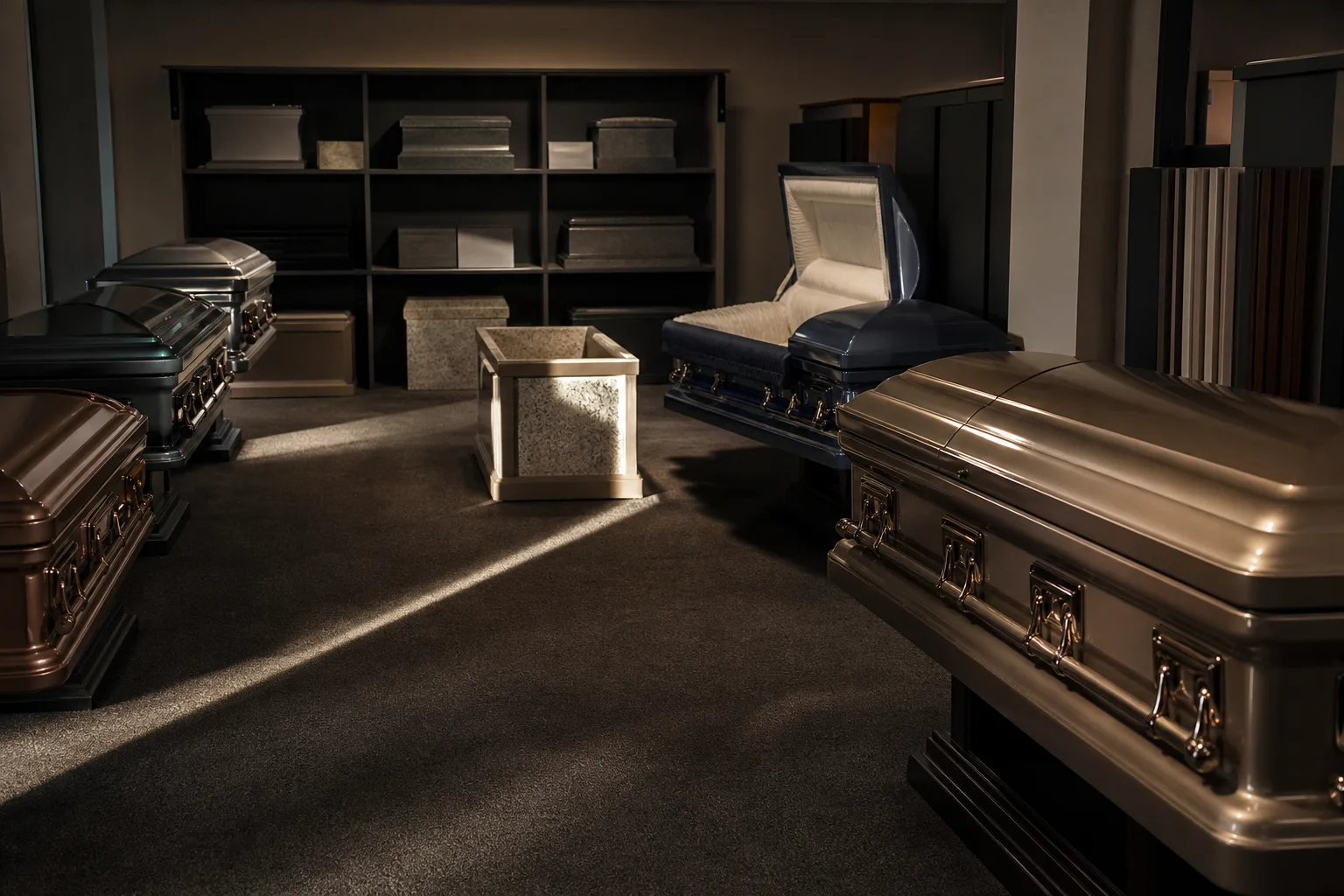
A funeral home selection room is a merchandising space, and the arrangement of it is a professional decision rather than an accident of the floor plan. Units are placed in an order, at heights, in a sequence of finishes, and the effect of that sequence on what a family selects has been studied by the industry for decades. None of this is hidden, and none of it is improper. It does mean that a buyer who understands the layout is working with better information than one who does not, particularly when the buyer is tired, grieving, and making the choice inside a two-hour appointment.
The Federal Trade Commission is responsible for the rule governing how funeral goods and services are priced and disclosed to consumers, including the requirement that a written casket price list be available before selection begins. That document is the single most useful object in the room, and it is frequently the one nobody hands over unprompted. Ask for it, and ask for it at the door rather than at the end.
Where the expensive units are standing
Most selection rooms present full units, quarter units, or panel displays, and each format changes what a buyer can compare at a glance. Full units occupy the most floor space and are typically concentrated in the middle price bands, where a funeral home does the bulk of its volume. The least expensive offerings are often placed at the corners of the room, near the entrance where a visitor has not yet settled, or displayed as a panel and a corner sample rather than a whole unit with the lid raised. That is not concealment; it is space allocation. But the practical consequence is that the cheapest option is the hardest one to picture with someone lying in it.
Height matters as well. A unit on a low stand reads as a lesser thing, and a unit at waist height with the interior lit reads as the default. Walk the whole room once before you look at anything closely, and note which price bands are represented by full units and which are represented by a swatch. The price list will tell you what exists in the building or can be ordered; the floor tells you only what the room was arranged to show.
The half-couch lid and what it emphasizes
The half-couch design, in which the upper portion of the lid opens independently and the lower portion stays closed, is the dominant configuration in American selection rooms. It frames the head and shoulders, exposes the interior fabric, the cap panel and the pillow, and leaves the foot end as a plain surface. A full-couch lid opens the entire length and shows the whole interior at once. The half-couch arrangement concentrates attention on the finished, upholstered, visible third of the unit, which is precisely the third that carries the decorative cost.
This is worth knowing because interior treatment can account for a meaningful part of the price difference between two units built from identical shell material. Crepe, twill, velvet and taffeta interiors differ in cost; so do hand-set cap panels and adjustable bed hardware. A buyer looking into a half-couch opening is looking at the parts that vary most and the parts that vary least all in one view, without any obvious signal telling them which is which.
What the decision actually costs
The container is one line on a bill that contains several, and the ones that arrive after it are easy to underestimate. A grave liner or outer burial vault is often required by the cemetery rather than by law, and its price can approach or exceed the price of the container itself once a sealed or lined model is selected. Opening and closing fees, the marker foundation and endowment care are cemetery charges that arrive separately. A family that spends its entire budget in the selection room, then meets the cemetery's price list an hour later, has effectively made two decisions while only being shown one.
Purchase route affects the total as well. A Coffin or casket bought from a third-party retailer must be accepted by the funeral home without a handling fee, and shipping timelines have compressed enough that this is a live option even on a compressed schedule. The trade-off is coordination: someone has to confirm the delivery, verify the interior dimensions and hardware, and be present when it arrives.
How to slow the room down
Take the printed price list to a chair and read it before walking the floor. Write down a ceiling number in advance, including an allowance for the vault, and say it out loud to the funeral director, who is generally willing to work within it and cannot make useful suggestions without knowing it. Ask what the same shell costs in a different interior, ask which units are stocked and which are ordered, and ask what the cemetery requires before agreeing to any outer container. Bring someone who is not the primary decision-maker, because a second person will remember what was said about gauge, seals and delivery when the first person will not.
The room is arranged well, and it is arranged for a reason. Reading the price list first, walking the whole floor before stopping anywhere, and treating the cemetery's requirements as part of the same purchase turns a sequence someone else designed into a comparison you control.
Full units versus panels
Mid-priced models are usually displayed as complete units, while the cheapest offerings often appear as a corner sample or fabric swatch. The display format reflects floor space and volume, not build quality.
Half-couch lid defined
A half-couch lid opens only the upper portion, leaving the lower half closed during viewing. It is the standard configuration in most American selection rooms.
Where the decoration sits
The visible third of a half-couch unit contains the cap panel, pillow and upholstered interior, which are the elements that vary most in cost. The unseen foot end is largely identical across price bands.
| Interior fabric costs | Crepe, twill, velvet and taffeta interiors carry different prices even when the outer shell is the same material and gauge. Ask what an identical shell costs in a plainer interior. |
| Display height signals | Units placed at waist height with lit interiors read as the default choice, while low stands read as lesser goods. Walking the entire room once before stopping anywhere neutralizes the effect. |
| The vault is separate | An outer burial vault or grave liner is usually a cemetery requirement rather than a state law, and it is billed separately from the container. Its cost can rival the casket once a sealed model is chosen. |
On this site
Cemetery charges that follow. Opening and closing fees, marker foundations and endowment care are cemetery line items that arrive after the funeral home bill. Budget for them before committing to a container price.
Third-party purchase rights. A funeral home must accept a container bought elsewhere and may not charge a handling fee for doing so. The buyer takes on the coordination of delivery timing and dimension checks.
Bring a second person. A companion who is not the primary decision-maker will retain details about gauge, seals, stock availability and delivery dates. Grief reliably degrades recall during a two-hour appointment.